JM104: What is Philosophy?
Conceptual Thought as an Act of Creation
This course starts May 7, 2026.
When it was published in 1990, Deleuze and Guattari’s final work, Qu’est-ce que la philosophie?, was a source of bafflement for many readers. Primed for another madcap foray into the radical iconoclasm of the duo’s previous bestsellers, Anti-Oedipus and A Thousand Plateaus, many were disappointed to find, in its pages, an uncharacteristically sober meditation on the Western philosophical tradition. To make matters worse, this meditation hinged on a neat classification of philosophy as a discipline distinct from art and science: philosophy envisioned as an autonomous endeavour—detached, self-referential, and, as Oscar Wilde once said of art, ultimately “quite useless.” It did not help to know that Deleuze largely wrote the book on his own, including Guattari’s name more as a token of friendship than as a seal of actual co-authorship.
To this day, the book is too often misunderstood, sometimes willfully so. In this course, independent scholar and Weird Studies co-host J.F. Martel will show how What Is Philosophy? is not just a groundbreaking work; it is the key that unlocks Deleuze’s project as a whole. Indeed, it is a guide to a philosophy of the future—one which, having abandoned all pretense of ultimate truth and decided to operate on its own terms, can finally acknowledge its grounding in the creative imagination.
In Deleuze, philosophy becomes the art of creating concepts—nothing more and nothing less. But what is a concept? What can a concept do? Answering these questions, Martel will present Deleuze as a thinker irreducible to the movements and trends with which he is traditionally associated: a deeply innovative philosopher who deserves every comparison to the artist, the magician, and the mystic that his commentators have dared in less cautious moments.
In the end, this is a course on philosophy tout court: an attempt not just to read Deleuze’s words on the subject, but to descry the spirit in which they were written. The goal is to express a new vision of conceptual thought, a “weird” one that follows philosophy’s tangled roots into the rich soil that has given us poetry, prophecy, and sorcery.
Format
The course consists of five weekly lectures, each 90 minutes long, and as many “office hours” sessions, where students can ask J.F. questions and contribute their own ideas to the evolving discussion. The course includes a dedicated feed where the instructor and students can post thoughts, share links, and engage in discussion between Zoom sessions.
Schedule
The course begins on Thursday, May 7, 2026, and ends with a final group discussion on Sunday, June 7. All meetings take place over Zoom via the Weirdosphere learning platform.
Lecture Hall sessions will take place on Thursdays, at 5 pm Pacific / 8 pm Eastern. These meetings are recorded to allow students in more distant time zones to attend asynchronously.
Office Hours sessions will take place on Sundays, at 12 pm Pacific / 3 pm Eastern. This time slot is chosen to allow students from as many time zones as possible to attend live. Like the lectures, these sessions will be recorded.
All of the recorded sessions will remain available to registered students after the course is over, in video and audio format.
Homework
The course is structured around the book What is Philosophy? by Gilles Deleuze and Félix Guattari. Reading is entirely optional, but interested students have the opportunity to read the book as the course progresses. We suggest beginning your reading after the introductory lecture.
Why Take This Course?
Students will:
Instructor Bio
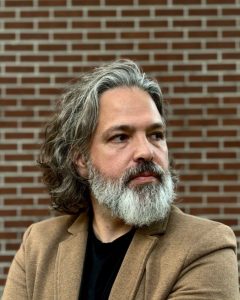
J.F. Martel is a Canadian author, filmmaker, lecturer, and cultural critic known for his work on the arts, philosophy, and the uncanny. With a background in film production and an interest in metaphysics, Martel explores the intersections of creativity and the ineffable, challenging conventional boundaries of understanding. He is best known for his book Reclaiming Art in the Age of Artifice, which argues for the intrinsic value of art beyond commodification and utilitarianism. Martel’s writings often appear in various publications, where he discusses the spiritual and existential dimensions of culture. As a filmmaker, he has directed several documentaries and short films. Through his work, Martel invites audiences to reconsider their perceptions of reality and embrace the mysteries that lie beneath the surface of the workaday world. He co-hosts the Weird Studies podcast with the music historian Phil Ford.